Ye Yint Nge — 20 October 2026
On 8 October, Reuters published an exclusive report. Michael Vance, head of the US State Department's Bureau of Intelligence and Research, came to Naypyidaw on 15–16 September and met Min Aung Hlaing, according to the report. It was the highest-level contact between the United States and the military government since the 2021 coup.
On 16 October, Reuters published another piece — there had been a follow-up meeting in Tokyo, and that meeting took place earlier that week (the 16th is the date the story was published, not the date of the meeting). More than a dozen US officials led by Vance attended. But who attended from the Myanmar side, and what was discussed — Reuters itself does not know, and neither side is saying anything.
The secrecy itself is the core point of this story. That the talks were led by an intelligence chief rather than a regional diplomat, that the sources go unnamed, that both capitals are silent — all of this shows that this is not yet a normal resumption of relations; it is a probing operation, feeling out the edges.
The proximate causes run like this. American businessman Adam Castillo was detained at Yangon airport on 11 June and was released and deported on 16 September — visibly coinciding with Vance's trip. On cracking down on scam centres, the US Federal Bureau of Investigation (FBI) has asked to engage directly with the Myanmar side. Rare earths are the subject that keeps resurfacing. And the junta has hired lobbyists in Washington — Reuters reports that the DCI Group, where Roger Stone serves as an adviser, has been hired on behalf of Myanmar's Ministry of Information since April 2026, according to documents filed under the Foreign Agents Registration Act (FARA). Lowy Institute researcher Hunter Marston told Reuters that this administration views Myanmar through a "purely transactional lens," and that rare earths could be the key strategic asset.
Bait, or a bridge?
Let me state my view directly — Min Aung Hlaing is not considering turning toward America. This is a man who is already fully inside the anti-Western axis camp. His weapons come from Russia; his lifeline comes from China. Sounding out the Americans is most likely bait — meant to make China and Russia take more interest in him and bid his price up further.
Look at the evidence. China was embracing him long before the American channel appeared. Wang Yi came to Naypyidaw and met him on 25 April. From 15–19 June, Min Aung Hlaing made a state-level visit to China, met Xi Jinping, signed 18 memoranda of understanding, and spoke of the China-Myanmar Economic Corridor (CMEC) as the flagship project. A man thinking of switching sides would not first stage a ceremony of that scale in Beijing.
Every analyst's conclusion is the same — this is not a switch; it is a hedge. China is the irreplaceable patron; Russia is a second patron that is deepening but has brought no money yet; America is the thinnest layer — its value is only the whiff of legitimacy, and the chance to signal to Beijing: "I have options."
What he feeds to whom
He pays every patron in a different currency.
To America he feeds words. On 11 July 2025, after receiving Trump's notice of a 40 percent tariff, Min Aung Hlaing himself wrote a letter asking to negotiate tariff rates and lift sanctions. Talk of rare-earth access had been reaching Trump's team since July 2025. Add the Castillo release and talk of scam-centre cooperation. What did he get back? On 24 July 2025, several of his allies were removed from the sanctions list (US officials denied any link to the letter), and on 9 October 2026 a single person, Theint Win Htet, was delisted. That is all. Not a lifting of the sanctions regime as a whole.
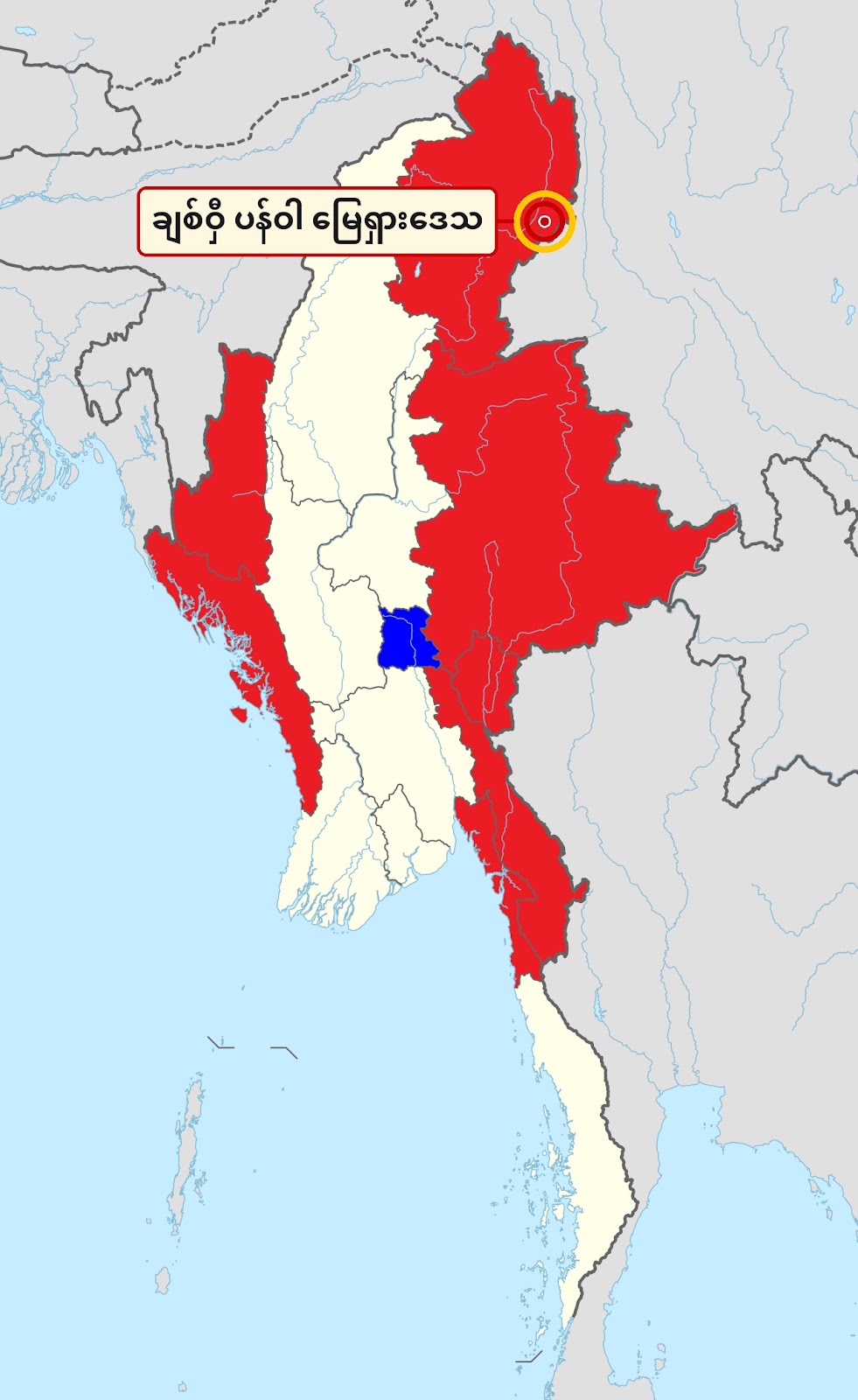
To China he feeds real things. The handing back of Lashio — the Myanmar National Democratic Alliance Army (MNDAA, the Kokang army) withdrew from Lashio on 21 April 2025, and the next day army units re-entered under Chinese supervision. At the Ta'ang National Liberation Army (TNLA) Kunming ceasefire (27–28 October 2025), Mogok and Momeik had to be handed back. In February 2025, he enacted a Private Security Services Law so Chinese security companies could come in. He hands scam suspects over to China en masse. What he gets back is weapons — FTC-2000G fighter jets, drone technology, technicians from the Tatmadaw's own factories (according to Stimson Center records), election backing, and pressure applied to ethnic armed organisations (EAOs).
To Russia he feeds cash and loyalty. On 15 December 2024 he took delivery of the last two of six Su-30SME fighter jets — a contract bought with a $400 million Russian loan. In February 2026 came a multi-year military cooperation agreement, the Tiger-2026 exercise, a satellite imagery centre, and the settlement of roughly two-thirds of bilateral trade in rubles. What he gets back is promises. Memoranda of understanding for a port, an oil refinery and energy projects at the Dawei Special Economic Zone have been signed since February 2025, but there is still no final decision on the refinery to this day. At the August 2026 Putin–Min Aung Hlaing meeting, talk resurfaced of LNG supply and of Russian companies being "ready to take part" in offshore oil and gas exploration. But the only Russian oil company named in the original documents is Zarubezhneft — the name Rosneft appears nowhere. The money line is not closed, there is no final investment decision (FID) yet, and there is no Russian naval base agreement — what exists is joint naval exercises in the Andaman Sea and port calls at Thilawa. To make those promises look real, he has since July 2026 deployed some 700 troops in the Dawei area and been clearing land (Reuters, 21 August 2026). It amounts to paying with soldiers to keep Moscow's interest alive.
One piece of background is worth adding — Thai gas money is the real, practical base of this game. The Yadana gas sales agreement runs 30 years from July 1998 — it expires at the end of July 2028. Thailand's PTTEP company (PTTEP) owns 62.963 percent; the Myanma Oil and Gas Enterprise (MOGE) owns 37 percent. The volume delivered to Thailand has fallen from 434 million cubic feet per day (434 mmscfd) in 2021 to about 150 million by May 2026, and no extension has been signed to date. The Yetagun field has nothing to do with this — its production stopped back in 2021. Which means Russia's paper promises cannot replace the real dollar income flowing from Thailand — if that income stops, he is the one hurt first.
The tilt verdict — he is not leaning to one side only. China is the deeply rooted patron; Russia is the second patron supplying arms and recognition; America is the newest and thinnest hedge. His method is to pay every patron in different money and keep every payment reversible — memoranda to Russia, words to America, acts of compliance to China.
Would he dare kick China out?
He would not dare. Let me say it plainly — he neither dares to, nor can he.
Look at the Lashio lesson. In April 2025, Beijing told him to hand back a city — and he handed it back. China holds a great many locks — opening and closing border trade, restraining or unleashing the northern EAOs, the Kyaukphyu–Kunming pipelines, protection at the UN Security Council. Beijing's very toleration of Operation 1027 in October 2023 was punishment for the military government not listening to China on the scam-centre issue — he has lived that experience.
So what he is really doing is not kicking China out — it is raising his own price with Beijing. He shows off talks with Washington, shows off contracts with Moscow, and lets Beijing take the point: "Without me, things will be hard for you too." The danger is not expulsion — it is that within that price-raising game, he may go hunting for scraps of American recognition.
Would China turn toward the SCEF?
Let us consider one question — if he truly broke with Beijing, would China turn and support the resistance side, and the SCEF in particular?
The short answer — there is no evidence that would happen. The SCEF is a coalition formed on 30 March 2026 by the National Unity Government (NUG), the Committee Representing Pyidaungsu Hluttaw (CRPH), the Kachin Independence Organisation (KIO), the Karen National Union (KNU), the Chin National Front (CNF) and the Karenni National Progressive Party (KNPP), aimed at abolishing the 2008 Constitution outright and placing all armed forces under an elected civilian government. Apart from the Kachin Independence Organisation (KIO), the SCEF contains no China-border groups. China's EAO channels run through the Federal Political Negotiation and Consultative Committee (FPNCC), led by the United Wa State Army (UWSA). China's special envoy Deng Xijun told FPNCC groups in Yunnan in December 2022 to keep their distance from the NUG — the NUG is "too close to the West" — according to records of the International Institute for Strategic Studies (IISS). The MNDAA's September 2024 announcement that it was ending cooperation with the NUG was likewise due to Chinese pressure.
According to a July 2026 analysis by Singapore-based ISEAS researchers (Htet Shein Lynn), China's handling of the EAOs is "risk-based peripheral management" — for Beijing the EAOs are not allies but tools for pressuring Naypyidaw, and it will not hesitate to switch which group it backs if its interests are harmed. So even if Beijing reached the point of falling back, its fallback plan would not be to recognise and arm the SCEF — it would be gradually unleashing the border EAOs, closing the border, cutting electricity, detaining EAO leaders (there is the precedent of MNDAA leaders being detained in Yunnan), and imposing economic punishment. Just as in the aftermath of 1027 — tolerate and let loose, then, once it widened, rein it back in.
That is why the SCEF cannot sit waiting for a Chinese rescuer. And Min Aung Hlaing himself knows this — it is because he knows how powerful Beijing's fallback weapons are that he does not truly dare to break.
What it means for the resistance — and how it can be turned to use
The danger first — Joshua Kurlantzick, a researcher at the Council on Foreign Relations (CFR), wrote on 8 October that US engagement hands the military government a gift of legitimacy, that obtaining rare earths is by no means certain, and that this comes after America cut assistance to the resistance. The 2 October statement by Representative Meeks follows the same line.
But the resistance side is not without cards.
First — rare earths. The thing Washington wants most is not in Naypyidaw's hands. The Kachin Independence Army (KIA) has controlled the Chipwi–Pangwa rare-earth belt since October 2024. In May 2025 China threatened the KIA — reopen purchases if it halts the Bhamo offensive, shut them off if it does not — but the KIA did not back down, and imports into China fell by roughly half year-on-year across January–May 2025, according to Reuters. Washington should not underestimate a group that even Beijing cannot move — this is the resistance's biggest weapon.
Second — Kyaukphyu. The Arakan Army (AA) controls most of the land around Kyaukphyu, and China itself already met the AA at Tengchong in December 2024. Resistance forces are sitting all around China's most important assets.
Third — the diplomatic channel. SCEF representatives met the Thai and Philippine foreign ministers in July 2026. The Philippines, the 2026 rotating chair of the Association of Southeast Asian Nations (ASEAN), is walking a dual track of engaging both the military government and the resistance. This is the counter-use — becoming the credible counterpart on the assets the great powers truly want (rare earths, the Kyaukphyu coast), and holding the American congressional channel described below.
The battlefield fact must not be forgotten either. According to National Unity Government (NUG) figures, the military government's airstrikes rose from 2,471 in 2024 to 4,881 in 2025 — Russian and Chinese aircraft, drones and technicians are the foundation of that resurgence. Every engagement that pretends not to see this is the same as buying the military government time.
Why November must be watched
The decisive moment of this game is the coming November election — the US midterm elections.
First, the legal foundation. Myanmar sanctions do not depend on the president's disposition. The BURMA Act, enacted in 2022, imposes mandatory sanctions on senior military government officials and on state enterprises that benefit the military. What the president can do extends only to talking, to delisting individuals under his own executive order (EO 14014), and to granting a waiver case by case by certifying to Congress that it is in the national interest. He cannot repeal the law. Early termination of the law would require certifications that political prisoners have been released, that an elected government has been restored or new free and fair elections held, that charges have been dropped, and that the constitution has been amended to place the military under civilian authority — none of which can honestly be produced.
Congress's position is also anti-junta on both sides of the aisle. The follow-up bill, the BRAVE Burma Act, passed the Republican-led House on 9 February 2026 — and remains in the Senate. A bipartisan House Foreign Affairs Committee letter likewise demands non-recognition and no senior-level engagement. To this day, not one Republican member of Congress has been heard endorsing the Vance channel.
Forecasts strongly favour the Democrats taking the House — Decision Desk HQ gives 77 percent, Kalshi 90 percent, and Pew Research says 55 percent of the American public expects a Democratic House. The new Congress will sit on 3 January 2027. The military government's interest is therefore clear — to seize irreversible gains quickly inside the window of congressional weakness, the lame-duck period from 4 November to 3 January: delistings, scraps of agreement.
The final point is Trump himself. This president has no fixed principles — he has only transactions. He is the kind of man who would not hesitate to trade again with a sanctioned Russia if he changed his mind. A channel opened by one whim can be closed again by one whim. Building a structure on Trump is like building a house on the weather — that is true for Min Aung Hlaing as well, and it may be exactly what he is underestimating.
In sum — Min Aung Hlaing is not changing teams. He is sitting inside a single team and auctioning off entry at the side door. He does not dare kick China out, Russia has not paid him yet, and America cannot lawfully give him anything lasting. The truly dangerous period is the next few months — the days before Congress changes. That is why there are things the resistance side must prepare in advance, instead of sitting back and waiting.
First — grip the congressional channel from now on. Full contact must be maintained with Meeks, the likely incoming chair of the House Foreign Affairs Committee, and with the supporters of the BRAVE Burma Act. If delistings are rushed through during the lame-duck period, evidence and lists of those harmed must be ready so a response can be made immediately.
Second — take a seat at the rare-earth table first. It is the Kachin side that controls the Chipwi–Pangwa belt — that fact must be stated in Washington directly and plainly. If a transparent management framework that protects the environment and local interests can be published in advance, America gains a reason to bypass the military government and talk to a legitimate counterpart.
Third — make the SCEF the single negotiating table. Engagement with the Philippines, ASEAN's 2026 rotating chair, and with Thailand must be kept deepening. The military government's bilateral ceasefire game aims to peel the forces apart one by one — the ranks must be bound together beforehand so they cannot be split.
Fourth — have alternative border routes ready. If Beijing closes the gates in anger, India and Thailand routes must be able to step in at once, with prior agreements among the northern allies. If you depend on a single trade route, the owner of that route can always name his price over you.
Fifth — do not stop gathering evidence. Airstrikes and harm to civilians must be documented systematically, and the freshest information kept reaching the hands of Congress and of news organisations. Decisions to impose further sanctions on jet fuel and on the military's banks rest on precisely that evidence.
In a season when the great powers compete, the side that fares best is not the side holding the cards — it is the side that has taken its own seat before the table is even set.