
Myanmar in Late 2026: Who Really Controls Where You Live
Ye Yint Nge — October 25, 2026
Five years after the February 2021 coup, Myanmar no longer has a single ruler. It has a patchwork. The military government holds the big cities and the central plains. Ethnic armed groups and resistance forces hold much of the countryside and the borders. Between them lies a wide contested zone where control changes from township to township, and sometimes from village to village.
Independent estimates put the military's firm control at roughly 21 to 33 percent of the country's territory. A United Nations briefing cited about 21 percent. Resistance forces held about 42 percent by mid-2026, according to one field survey. The Myanmar Peace Monitor counted 104 towns seized by resistance forces since the coup, of which the military had retaken only 17 as of May 2026.
This is the map that matters now — not the flag in Naypyidaw, but who collects the tax at the gate, who mans the checkpoint on your road, and whose shells fall on your town.
The map
The map below shows the broad picture as of October 2026, by state and region. It is an approximation at that level: within each coloured area, towns and countryside often differ. The pattern to remember is simple. The military holds towns and highways. Its opponents hold the hills and the borders.
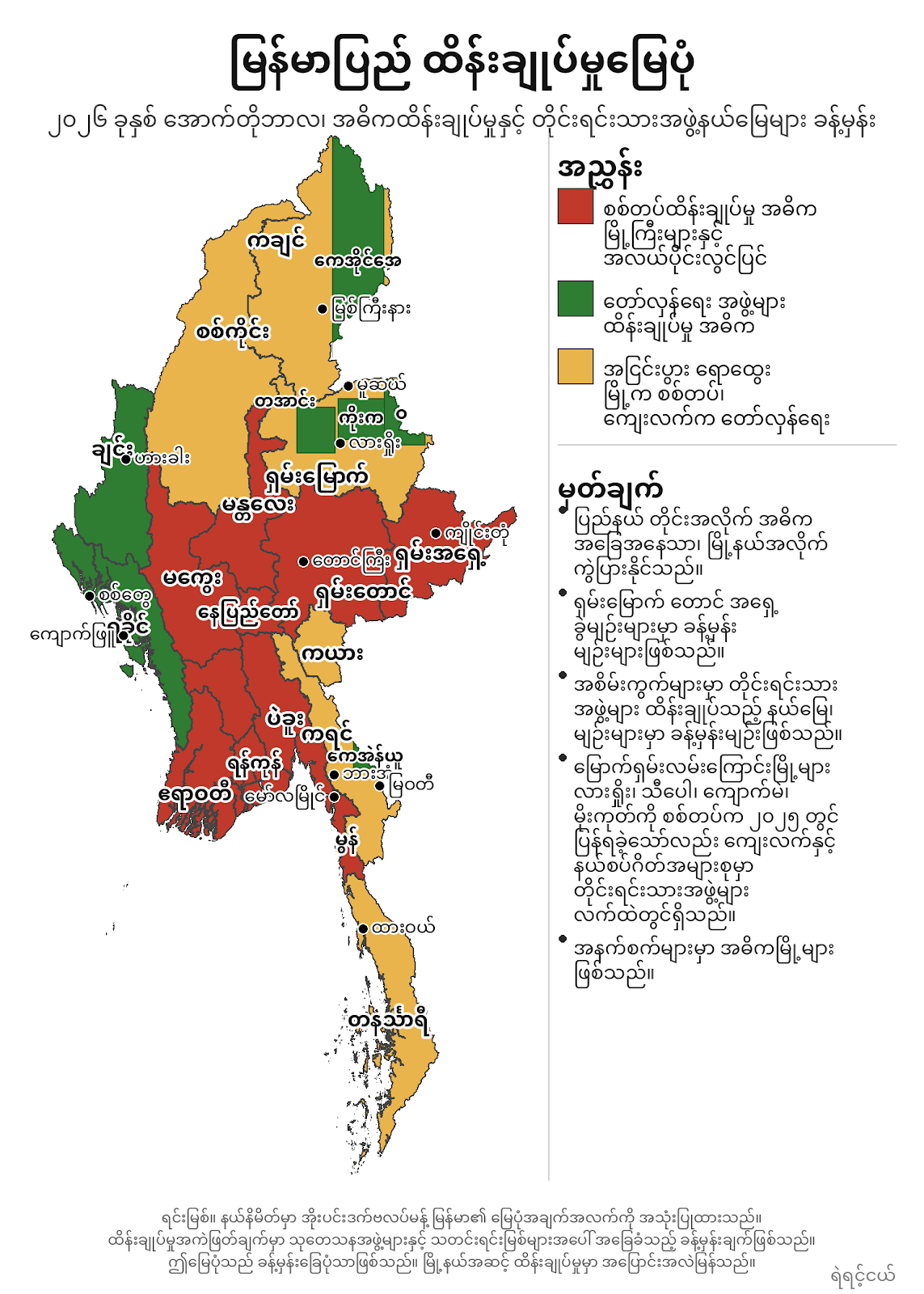
Map: dominant control, October 2026, with approximate ethnic armed group zones. Estimate by the author, based on ISP-Myanmar, the Myanmar Peace Monitor and news reports. Township control varies, and zone boundaries are approximate.
The north: corridor towns retaken, gates still lost
In 2025 the military clawed back a chain of northern Shan towns: Lashio in April, handed back after Chinese pressure; Nawnghkio in June, after 45 days of fighting; Kyaukme on September 30, after a 21-day assault; Hsipaw on October 16, after a 16-day push; and Mogok and Momeik on November 30 and December 1, handed over under the China-brokered ceasefire with the Ta'ang National Liberation Army (TNLA).
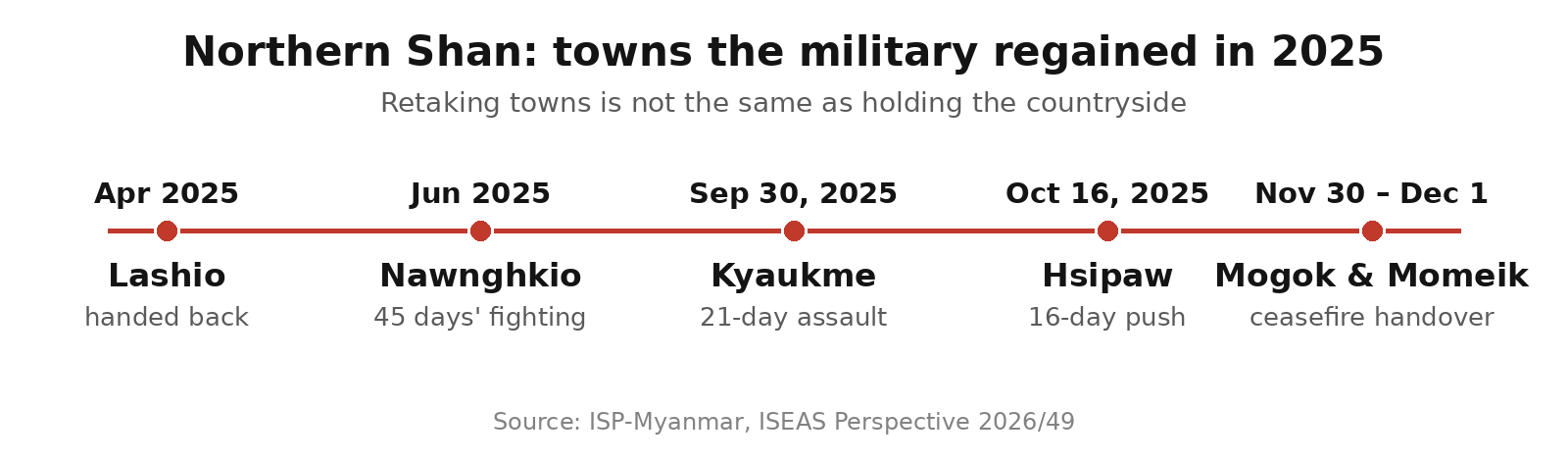
Timeline: northern Shan corridor towns regained by the military in 2025. Sources: ISP-Myanmar, ISEAS Perspective 2026/49.
But retaking towns is not the same as holding the corridor. Even after Hsipaw fell, the military controlled only 44.4 percent of the Mandalay-Muse trade route, according to ISP-Myanmar. The stretch of highway between Hsipaw and Lashio remained under the Myanmar National Democratic Alliance Army (MNDAA). And the border gates — the real prize — are mostly gone. Of 19 border gates, only 6 have reopened, with restrictions. The MNDAA now controls the largest number of China-border trade gates in northern Shan, after seizing Kutkai and corridor routes from the TNLA in March 2026. Trade figures tell the same story: stations held by ethnic armed groups account for about 91 percent of China-border trade value, against about 9 percent for junta-held stations. Gate tax goes to whoever holds the gate.
Muse town itself shows the split. The military still holds its base in the town, but the trade gates are divided: the MNDAA controls the Kyinsankyawt and Kyukoke gates, and the military holds only the Man Wein Gyi gate, reachable solely through the Three Brotherhood Alliance's 105-Mile Trade Zone.
The west: Rakhine nearly gone, Sittwe under siege
The Arakan Army (AA) now controls all of Rakhine State except the townships of Sittwe, Kyaukphyu and Manaung, plus Paletwa in Chin State, according to The Irrawaddy. The week of October 17 to 23 showed how the siege of Sittwe is going: the military twice tried to land troops on Ngapyi Island opposite the city; the AA says it sank a landing craft on October 17 and later killed at least 10 troops, with more than 20 surrendering. On October 22 the AA took a junta outpost on the northwestern shore of the Sittwe peninsula. On October 23 a military plane bombed Sittwe city itself, killing 11 civilians, according to People's Spring and Mizzima. Casualty figures from the conflict parties are single-sided and independently unverified.
Kyaukphyu matters beyond Rakhine. It is the deep-sea port and the terminus of the China-Myanmar oil and gas pipelines. The AA has besieged it without storming it, and its spokesman said in June that the group is in discussions with Chinese officials about Rakhine investments, including the port and the pipelines, and has reached agreements to protect them. The AA has also said some deals may need renegotiation once it governs independently. The port is leverage to be taxed and negotiated over, not destroyed.
The other fronts, in one week
In Kachin State, the Kachin Independence Army (KIA) began a renewed attack on Bhamo from seven directions on October 20, with no breakthrough reported. The military has reinforced about 3,000 troops there and flies up to 50 airstrikes a day, according to a CSIS analysis. On October 12, troops of the 33rd and 88th Light Infantry Divisions burned the Htingnan Kachin Baptist Church in Three Mile, Bhamo, according to The Irrawaddy and Christian Solidarity Worldwide, cited by the Christian Post.
In southern Chin State, a military column fought to within 3 kilometres of Kyindwe, falling from about 500 troops to about 300, according to Mizzima and Burma News International. Mindat and Kanpetlet remain uncracked. An airstrike on a boat landing at Chaungson, Paletwa, on October 18-19 killed at least 20 civilians, including children, according to Khit Thit Media.
In Sagaing Region, military troops retook Mezah village on the Indaw-Htee Chaing-Katha road but retreated on October 20; residents later found about 50 hastily buried military corpses, according to People's Spring. The KIA overran junta-proxy Shan Nationalities Army camps in Homalin on October 18-19 and 22. More than 1,000 military troops retook the border town of Kampat, but resistance fighters remain and road traffic is still blocked, according to Mizzima.
In Ayeyarwady Region, the military suffered heavy losses against the AA and allied resistance fighters in Thapaung Township, with at least 20 killed including officers, according to the Ayeyarwaddy Times on October 18.
In Karen State, Myawaddy town is back in military hands — it appears on the list of towns the military has retaken — while the Karen National Union holds much of the countryside. In Karenni State, the capital Loikaw has been besieged by Karenni fighters for about two years.
A new title in Naypyidaw, the same power
Min Aung Hlaing is now President of Myanmar. He was elected by parliament on April 3, 2026 and inaugurated on April 10, the same day he formed a new Union Government with a 34-member cabinet largely carried over from the junta, according to Reuters and the International Crisis Group. The staged general election in December 2025 and January 2026 was won in a landslide by the army-backed Union Solidarity and Development Party, with most opposition parties barred. Min Aung Hlaing stepped down as Commander-in-Chief on March 30, 2026; loyalist Ye Win Oo succeeded him. The change gives the military government a civilian-looking front for diplomacy. The power structure behind it is unchanged.
The brokers: Beijing, Washington, Moscow
China remains the broker of the map. It opens and closes border gates, brokers the ceasefires, and deals with whoever holds the ground — the military government, the MNDAA, the TNLA, the United Wa State Army and the AA alike. Its last major engagements were Foreign Minister Wang Yi's visit to Naypyidaw on April 25, 2026 and Min Aung Hlaing's state visit to China on June 15-19, 2026. A CSIS analysis says China has stepped up military assistance to the junta, partly to defend Bhamo; that framing is single-sourced and should be treated with care.
The United States has opened a second channel. Assistant Secretary of State Michael Vance met Min Aung Hlaing in Naypyidaw on September 15-16, 2026, and a second round followed in Tokyo, led again by Vance with more than 12 US officials, according to Reuters on October 16. The stated focus was the release of an American businessman and shutting scam centres targeting Americans, with rare earths raised as a possible broader engagement. Reuters reports that proposals heard by US officials include brokering a military-KIA deal — or engaging the KIA directly, bypassing Naypyidaw. No agreement has been announced.
Russia is the third patron. President Vladimir Putin hosted Min Aung Hlaing in Moscow on August 18, 2026, where Russia said it is in talks on an oil refinery and hydrocarbon production and exploration, including on Myanmar's continental shelf, plus liquefied natural gas supplies, according to Reuters. No project company, site, capacity, investment amount or timetable has been disclosed. It is an early-stage discussion, not a committed project.
What it means for ordinary people
For most people in Myanmar, the map is not an abstraction. It decides the price of goods, because whoever holds the gate taxes the truck. It decides whether you can cross a border, because most gates are still shut. It decides whether your town is shelled, because airstrikes now reach cities like Sittwe that were once behind the lines. And it decides who you must answer to — a military administrator in the town, or an ethnic armed group's administration in the hills. The flag in Naypyidaw matters less, day to day, than the checkpoint on your road.
What comes next: three scenarios
Analysts sketch three paths. The first, judged most likely by the Asia Pacific Foundation, is frozen fragmentation: unstable military-led rule in the centre alongside quasi-autonomous peripheries, with humanitarian crises enduring and a negotiated federal settlement the least likely outcome. The second, from the International Institute for Democracy and Electoral Assistance (IDEA), is a prolonged stalemate: the military keeps the cities, the resistance consolidates its areas, and local authorities build semi-functioning statelets. The third is the hopeful one: deeper resistance coordination forces the military to negotiate with less leverage, opening a path to an asymmetric federal system that recognises the autonomy each region has already carved out. IDEA itself warns that such a settlement would take years of complex negotiation. The Lowy Institute adds a fourth possibility — that the regime's financial crisis could one day make it simply cease to function — but notes that even then, the outcome would be a mix of scenarios in different parts of the country, not a clean victory.
Hints, not verdicts
This article offers hints, not verdicts. Those who strive will get what their striving earns. The hints are these.
First, China manages the map; it does not own it. It restrains every side, including the military government it still recognises, because a stable border and open trade matter more to Beijing than any one ruler in Naypyidaw.
Second, the real front line is no longer between states. It is between towns and countryside. Whoever holds the town collects the revenue; whoever holds the countryside decides whether the road stays open.
Third, fragmentation is hardening into administration. The Wa, Kokang, Ta'ang, Arakan and Kachin areas are not just battlefields any more. They are governments in waiting, with their own taxes, schools and courts.
Fourth, the decisive question of the next five years is whether the resistance can turn battlefield coordination into a political alternative before exhaustion sets in. Communities that have sustained five years of war have not yet seen their daily lives improve. That patience is not infinite, on any side.
The map rewards whoever holds ground, not whoever holds the title. That is the one fact every side in Myanmar now has to reckon with.
Sources
ISP-Myanmar (Mapping No. 84 and April 2026 analysis); BNI Myanmar Peace Monitor (May 2026); ISEAS Perspective 2026/49, "Managing the Margins"; IDEA, "Myanmar's Fragmented Future" (April 2026); Asia Pacific Foundation of Canada, "The Futures of Myanmar"; Lowy Institute, "Outrage is not a policy"; Reuters (April 3, October 8 and October 16, 2026); International Crisis Group; Burma Coup Resistance Notes (October 24, 2026), compiling People's Spring, Mizzima and Khit Thit Media; CSIS analysis of the Bhamo front; The Irrawaddy; Ayeyarwaddy Times (October 18, 2026); Christian Post (October 2026). Casualty figures attributed to conflict parties are single-sided and independently unverified.
မှတ်ချက်များ
Post a Comment